

Sleeping in Art: From Van Gogh to Klimt, The Hidden Stories of Famous Beds
Great artists, with their extraordinary sensitivity, have always understood this profound truth. In their masterpieces, the bedroom and the bed itself become powerful symbols—mirrors of the soul that tell us stories of solitude, love, anguish, and peace. Through their eyes, we can rediscover the deep meaning of this sacred space.
At Valle di Lana, we believe that creating a mattress is an act that requires not only artisanal wisdom but also a deep understanding of its role in people's lives. Join us on this journey through art history to rediscover the heart of the home.
1. Van Gogh's Bedroom in Arles: The Bed as a Refuge for the Soul
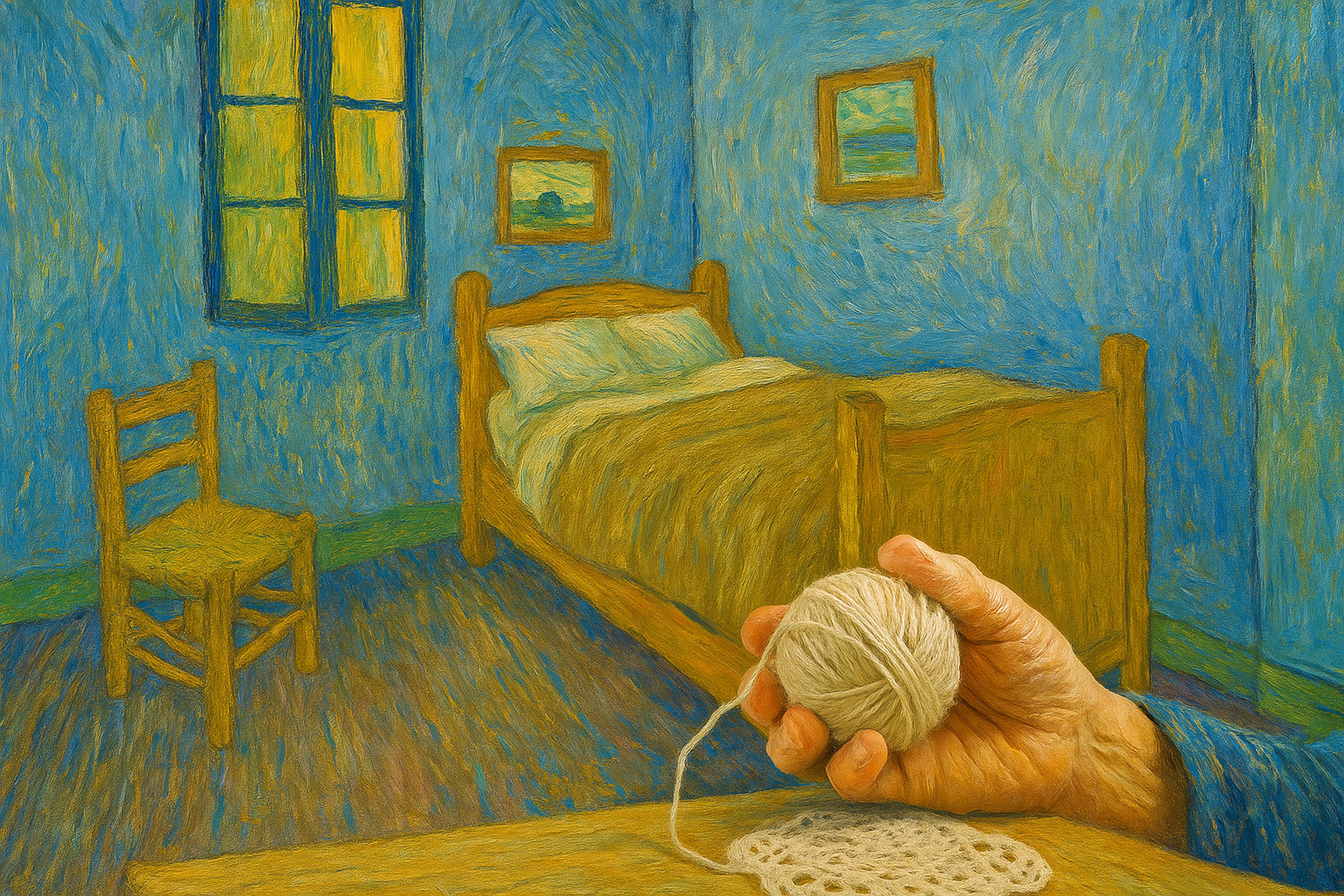
When we think of a bed in art, the image that comes to mind most vividly is perhaps "The Bedroom" (1888) by Vincent van Gogh. In this painting of vibrant colors and bold lines, everything converges towards the wooden bed—simple, robust, and yellow like fresh butter. It is not a luxurious bed, but it is solid, reliable, present.
Van Gogh painted this room not just as it was, but as he wanted it to be: a place of peace, order, and tranquility. In a life marked by torment, that room and that bed represented the hope of a refuge, a nest where his restless mind could finally find rest. The bed, in this masterpiece, is the symbol of the search for stability and a return to simple, essential things.
2. Klimt's "The Kiss": The Bed as a Secret Garden of Passion
In "The Kiss" (1907-08) by Gustav Klimt, we do not see a traditional bedroom, yet the scene is one of the most intimate and sensual in art history. The two lovers, wrapped in an almost sacred golden aura, are kneeling on a flowery meadow that acts as a symbolic bed.
This meadow-bed is not a simple background, but a magical space, a Secret Garden that isolates the couple from the rest of the world, suspending them in a time and space without borders. Here, the bed becomes the place of total abandonment, fusion, and ecstasy. It is a Love Nest where the precious textures of the robes mix with the colors of nature in an explosion of vitality and passion.
3. Munch's "The Sick Child": The Bed as a Witness to Vulnerability
Art, in its honesty, also shows us the other side of the bed. In works like "The Sick Child" (1885) by Edvard Munch, the bed ceases to be a place of rest and becomes the silent witness to human fragility, illness, and pain. It is the space where we are most vulnerable, where we face our fears and confront our finiteness.
This representation, though painful, reveals a profound truth: precisely because the bed is the place of our maximum vulnerability, it must also be the place of maximum care and maximum comfort. It must be a reassuring presence, an embrace that supports us in moments of difficulty. A healthy, clean, and welcoming environment becomes, then, not a luxury, but a fundamental necessity.
From Art to Life: Creating Your Own Masterpiece of Rest
What do these artists teach us? That our bed is much more than furniture. It is a refuge for the soul like Van Gogh's, a nest of passion like Klimt's, and a safe harbor in moments of fragility as Munch reminds us. It is the center of our personal universe.
The creation of a
Conclusion: Choose the Bed that Tells Your Story
Choosing your bed is a form of expression, a way to define the most intimate and important space in your home. It is a choice that should reflect your values: the search for authenticity, the need for comfort, and the love for things made well and made to last.
Just as a great artist chooses their colors, choose with care the elements that compose your sleep. Create a space that not only welcomes your body but also nourishes your soul.
Discover a mattress made with art.