

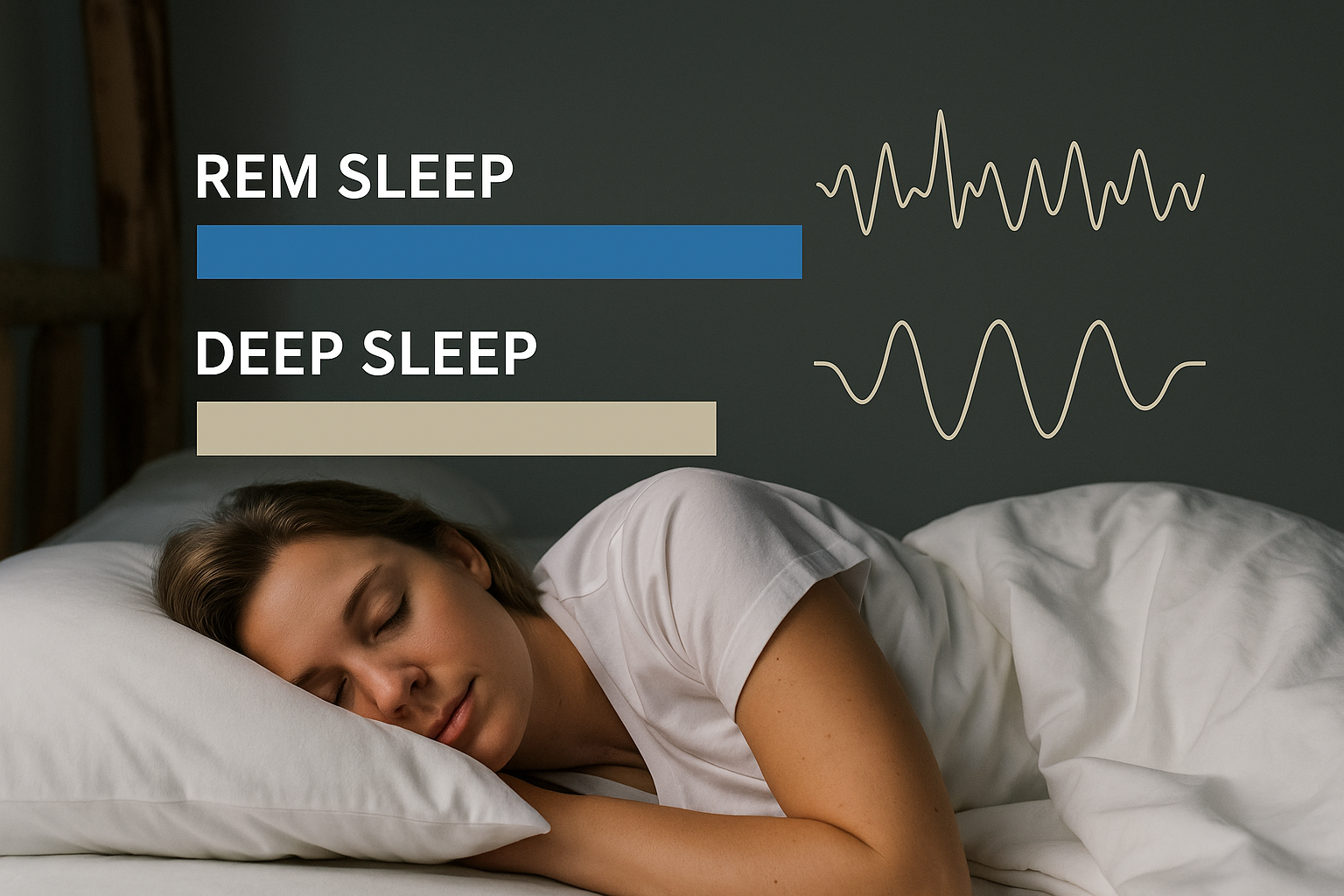
REM & Deep Sleep: It’s Not About How Long You Sleep, But On What.
If you have ever woken up after a full eight hours feeling like you haven't slept a wink, you are not alone. In the age of fitness trackers and bio-hacking, we are obsessed with the quantity of our sleep. We count the hours, set strict alarms, and brag about (or complain about) how long we slept.
But what if we told you your tracker is looking at the wrong thing?
The true secret to waking up energized lies not in how much time you spend in bed, but in how your brain moves through the complex stages of sleep. And, more importantly, in what you are using to support (or sabotage) that cycle.
Welcome to the world of Sleep Architecture: where quality beats quantity, and Deep Sleep and REM are the true protagonists.
Sleep Architecture: The Builder and The Librarian
Imagine your nightly sleep not as one long block, but as a series of 90-minute cycles. During each cycle, your brain moves through different stages, but two are absolutely vital for your well-being: Deep Sleep (NREM 3) and REM Sleep.
We can think of them as your nightly maintenance crew.
1. Deep Sleep (NREM 3): The Builder
This is the phase of physical recovery. It is here that your body does the heavy lifting:
-
Repair: Muscle and bone tissues are repaired and built.
-
Cleaning: The brain's glymphatic system activates to flush out metabolic toxins accumulated during the day (it literally "washes" your brain).
-
Reinforcement: The immune system regenerates, and crucial hormones, like Human Growth Hormone (HGH), are released.
-
If you miss Deep Sleep: You wake up feeling physically exhausted, sore, and more vulnerable to illness.
2. REM Sleep (Rapid Eye Movement): The Librarian
If Deep Sleep is about the body, REM is about the mind. It is famous for vivid dreaming, but its role is much more pragmatic:
-
Consolidation: The mind sorts information learned during the day, discarding the useless and filing the necessary into long-term memory.
-
Emotional Regulation: The brain processes emotional experiences, reducing the impact of stressful events (this is why "sleeping on it" really helps calm anxiety).
-
Learning: It is fundamental for creativity and problem-solving skills.
-
If you miss REM: You wake up mentally foggy, irritable, and unable to concentrate.
The Silent Saboteur: Why Your Mattress is Breaking Your Cycles
Here is the crucial point: to get the benefits of Deep Sleep and REM, these cycles must not be interrupted.
Your brain is programmed to enter Deep Sleep early in the night and spend more time in REM towards the morning. But every time something disturbs you—whether it's a noise, light, or physical discomfort—the cycle breaks. The brain has to "reboot," returning to a lighter stage of sleep, stealing precious time from the work of the "Builder" and the "Librarian."
The most common culprit of these interruptions? It’s not your snoring partner. It is Thermal Discomfort.
When you sleep on synthetic materials, like Memory Foam or Polyester, this happens:
-
The Heat Trap: These plastic-derived materials do not breathe. They reflect your body heat back at you, creating a superheated "bubble" between you and the mattress.
-
Sweating: Your body, in an attempt to cool down, sweats.
-
Trapped Moisture: Synthetic material cannot absorb or disperse this moisture. It stays trapped against your skin.
-
The Micro-Awakening: Your brain registers the discomfort (too hot, too damp, then suddenly too cold due to sweat evaporation) and kicks you out of Deep Sleep or REM, forcing you to toss, turn, or kick off the covers in a desperate attempt to find relief.
You slept eight hours, but they were eight hours of fragmented, low-quality sleep—a constant battle against your own bed.
The "On What" Matters: Wool as the Guardian of Sleep Architecture
If synthetic materials are saboteurs, Wool is an Active Regulator. It is the only material nature designed specifically to manage temperature and humidity to protect a living body. Wool doesn't just "sit there"; it works actively with your body to protect your sleep architecture.
1. Intelligent Thermoregulation
Wool does not "heat" (a common myth). Wool insulates and regulates. Its complex fibers create a perfect microclimate around your body. If you are hot, the fibers absorb excess heat; if you are cold, they retain it. This keeps your body in a stable "Thermal Comfort Zone," signaling to the brain that it is "safe" to stay in Deep Sleep without interruption.
2. Superior Moisture Management
Wool is hygroscopic. It can absorb up to 33% of its weight in water vapor (i.e., your night sweat) without ever feeling wet to the touch. It actively transports that moisture away from your skin and releases it into the air. Translation: You stay dry. No more sticky skin, no more cold shivers from evaporated sweat. No more micro-awakenings caused by discomfort.
Conclusion: Stop Counting, Start Resting
You can have the most advanced sleep tracking app in the world, but if you sleep on a surface that fights your biology, you are only measuring failure.
True rest is not measured in hours, but in the uninterrupted quality of your REM and Deep Sleep phases. To optimize these vital stages, your body must not waste energy fighting to regulate its temperature.
The next time you think about how to improve your sleep, don't just look at the clock. Look at what you are sleeping on.
Ready to protect your Sleep Architecture?